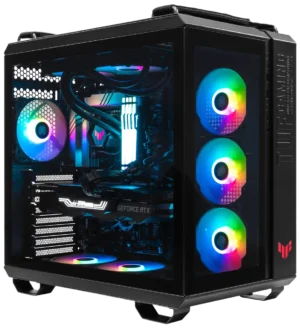
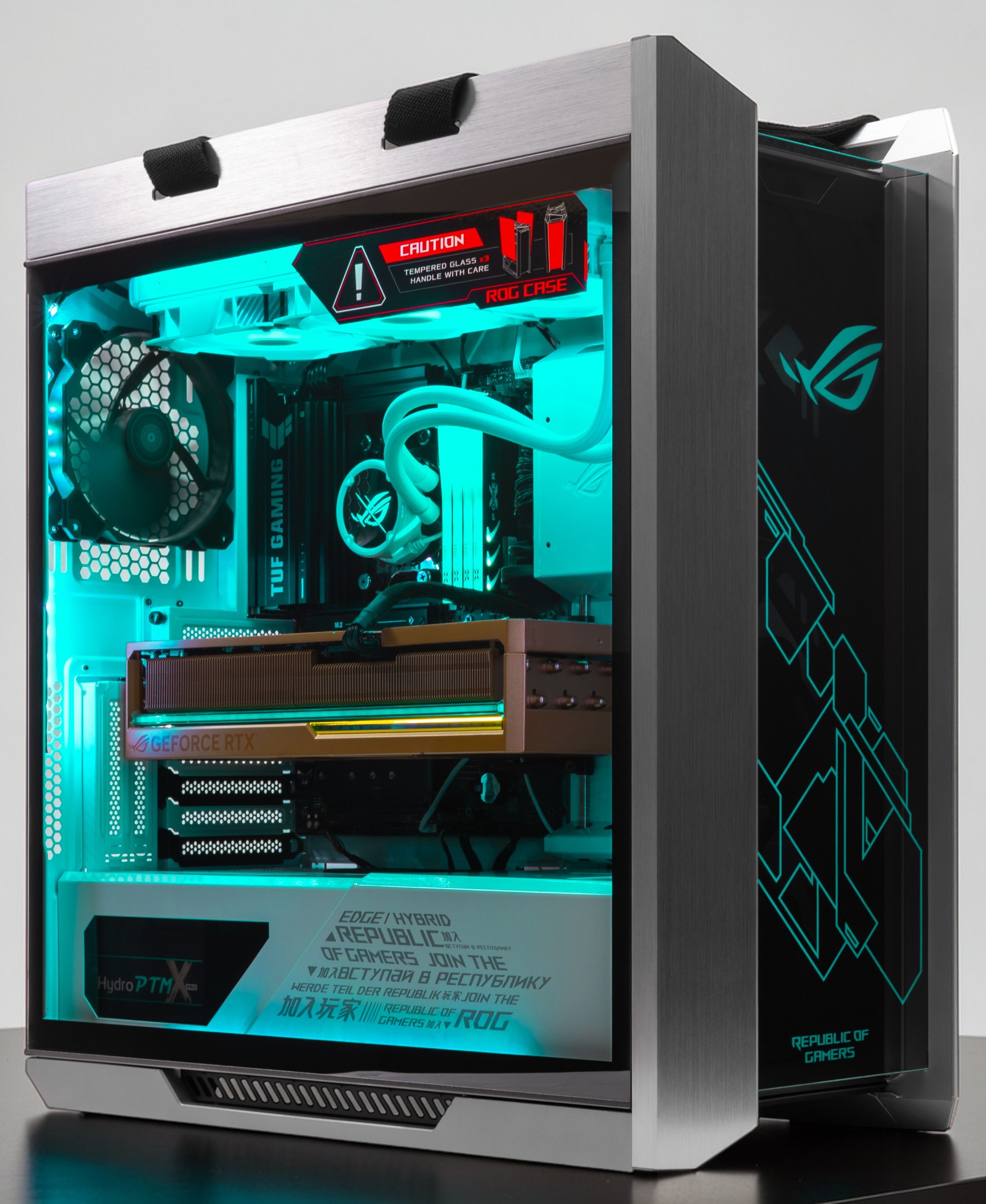
In this RTX 5090 vs RTX 5080 comparison, NVIDIA’s RTX 50-series flagship GPUs represent the pinnacle of gaming performance, but choosing between the RTX 5090 and RTX 5080 isn’t straightforward.
The massive price gap and performance differences demand careful consideration of your actual gaming needs, target resolution, and future-proofing goals.
At ArsenalPC, we’ve been hand-assembling custom gaming PCs in Willoughby, Ohio for over two decades of experience, and we’ve tested both GPUs extensively through comprehensive benchmarking and stress testing.
In the RTX 5090 vs RTX 5080 matchup, here’s everything you need to know about these powerhouse cards to make the right choice for your setup.
RTX 5090 vs RTX 5080: Key Specifications Compared
| Specification | RTX 5090 | RTX 5080 |
|---|---|---|
| CUDA Cores | 21,760 | 10,752 |
| RT Cores | 170 (4th Gen) | 84 (4th Gen) |
| Tensor Cores | 680 (5th Gen) | 336 (5th Gen) |
| VRAM | 32GB GDDR7 | 16GB GDDR7 |
| Memory Bus | 512-bit | 256-bit |
| Memory bandwidth | 1,792 GB/s | 896 GB/s |
| Base Clock | 2,040 MHz | 2,295 MHz |
| Boost Clock | 2,407 MHz | 2,618 MHz |
| TGP | ~575W | ~400W |
| MSRP | $1,999 | $999 |
| Street Price (March 2026) | $3,000-4,100+ | $999-1,400 |
The RTX 5090 doubles the RTX 5080’s CUDA cores and VRAM capacity while delivering substantially more memory bandwidth.
However, the RTX 5080 compensates with higher clock speeds, making the RTX 5800 vs RTX 5900 performance comparison more nuanced than raw specifications suggest.
RTX 5090 vs RTX 5080: Current Market Pricing
In this RTX 5090 vs RTX 5080 price comparison, unlike the RTX 5080, which trades near MSRP at $999-1,400, the RTX 5090 faces severe scalping with street prices reaching $3,000-4,100+ – well above its $1,999 MSRP. This pricing reality fundamentally changes the value equation for most buyers.
At ArsenalPC, we build PCs to order with confirmed GPU availability, ensuring our customers receive verified pricing without inflated markups. Our verified Amazon and NewEgg seller status helps us secure consistent stock allocation for both GPUs.
RTX 5090 vs RTX 5080 Gaming Performance Breakdown
RTX 5090 Performance Analysis
The RTX 5090 establishes itself as the uncompromised 4K gaming champion, particularly for native ultra ray tracing and path tracing scenarios. Based on internal testing using current game builds and driver versions:
4K Native Performance:
- Cyberpunk 2077 (Ultra, no RT): 85-95 FPS
- Call of Duty: Modern Warfare III: 110-125 FPS
- Starfield (Ultra): 75-85 FPS
- The Witcher 3 Next-Gen (Ultra): 95-110 FPS
- Alan Wake 2 (Ultra): 65-75 FPS
4K Native with Ray Tracing/Path Tracing:
- Cyberpunk 2077 (RT Ultra + Path Tracing): 35-45 FPS native, 85-100 FPS with DLSS Quality
- Alan Wake 2 (RT High): 45-55 FPS native, 75-90 FPS with DLSS Quality
- Control (RT High): 70-80 FPS native, 95-115 FPS with DLSS Quality
4K with DLSS + Frame Generation:
- Cyberpunk 2077 (RT Ultra + Path Tracing): 130-150 FPS
- Alan Wake 2 (RT High): 120-140 FPS
- Call of Duty: Modern Warfare III: 180-200+ FPS
The RTX 5090’s massive 32GB VRAM buffer eliminates texture streaming issues even in VRAM-intensive titles at maximum settings, providing substantial headroom for future game requirements over 5+ year upgrade cycles.
RTX 5080 Performance Analysis
The RTX 5080 delivers compelling 4K performance with DLSS/Frame Generation, making it excellent for high-refresh 1440p or quality-focused 4K gaming.
4K Native Performance:
- Cyberpunk 2077 (Ultra, no RT): 65-75 FPS
- Call of Duty: Modern Warfare III: 85-100 FPS
- Starfield (Ultra): 60-70 FPS
- The Witcher 3 Next-Gen (Ultra): 75-85 FPS
- Alan Wake 2 (Ultra): 50-60 FPS
4K Native with Ray Tracing:
- Cyberpunk 2077 (RT Ultra): 40-50 FPS native, 65-80 FPS with DLSS Quality
- Alan Wake 2 (RT High): 35-45 FPS native, 60-75 FPS with DLSS Quality
- Control (RT High): 55-65 FPS native, 80-95 FPS with DLSS Quality
4K with DLSS + Frame Generation:
- Cyberpunk 2077 (RT Ultra): 100-120 FPS
- Alan Wake 2 (RT High): 95-115 FPS
- Call of Duty: Modern Warfare III: 140-160 FPS
The RTX 5080’s 16GB VRAM handles current 4K gaming excellently, delivering 60-100+ FPS in most AAA titles with DLSS enabled, though future titles with higher texture demands may eventually require settings adjustments.
RTX 5090 vs RTX 5080 Performance Gap Analysis
At 4K native resolution, the RTX 5090 typically delivers 20-30% higher framerates than the RTX 5080, with gaps widening significantly in ray tracing and path tracing scenarios where the doubled RT cores matter most. However, when DLSS + Frame Generation is active, the relative percentage difference narrows as both GPUs scale proportionally from their base performance.
The RTX 5090’s architectural advantages – doubled CUDA cores, memory bandwidth, and VRAM capacity – provide substantial headroom for native ultra RT/path tracing where the RTX 5080 may require upscaling assistance.
RTX 5090 vs RTX 5080: Resolution-Specific Recommendations
1440p High-Refresh Gaming
Both GPUs excel at 1440p, but with different value propositions:
RTX 5080 at 1440p:
- 165-240Hz gaming with maximum settings
- Ray tracing at high refresh rates
- Future-proofing for demanding titles
- Excellent efficiency and easier system builds
RTX 5090 at 1440p:
- Only justified for 360Hz competitive gaming or extensive creative workloads
- Massive performance overhead for typical gaming scenarios
- Better suited for mixed gaming/professional use cases
For dedicated 1440p gaming, the RTX 5080 provides more than enough performance with significant cost savings.
4K Gaming: Where the RTX 5800 vs RTX 5900 Debate Matters Most
This is where the comparison becomes most meaningful:
RTX 5080 for 4K:
- Solid 60-100+ FPS in most titles with DLSS/Frame Generation
- Requires DLSS for demanding ray traced scenarios
- 16GB VRAM adequate for current and near-future titles
- Great efficiency with ~400W power draw
RTX 5090 for 4K:
- Uncompromised native ultra settings with ray tracing/path tracing
- Noticeably smoother experience in demanding titles like Cyberpunk 2077 and Alan Wake 2
- 32GB VRAM eliminates texture streaming concerns for 5+ year upgrade cycles
- True king for native 4K max RT without upscaling dependency
Content Creation and Professional Workloads
The RTX 5090’s advantages extend far beyond gaming:
- 32GB VRAM benefits large video editing projects and 3D rendering workflows
- Doubled RT cores accelerate Blender Cycles and professional visualization
- Professional applications leverage the additional memory bandwidth for heavy streaming/creation workloads
- Substantial productivity gains in AI workloads and machine learning tasks
Content creators working with 4K+ video, large 3D scenes, or AI applications will notice meaningful productivity improvements with the RTX 5090.
RTX 5090 vs RTX 5080: Price-to-Performance Analysis
The RTX 5090 vs RTX 5080 price difference is dramatic and alters the value equation significantly:
RTX 5080 (~$999-1,400):
- Excellent price-to-performance for flagship gaming
- Delivers 75-85% of RTX 5090 performance for ~25-35% of current street price
- Best value if your total system budget is under $3,500-4,000
RTX 5090 (~$3,000-4,100+):
- Massive premium over MSRP due to supply constraints
- Diminishing returns unless you exploit every ounce of extra performance
- Only justifiable for users who absolutely need native ultra RT/path tracing or professional workloads
The RTX 5090’s value proposition only strengthens for users requiring the longest possible upgrade cycle, uncompromised 4K ray tracing, or professional acceleration that can offset the inflated pricing.
RTX 5090 vs RTX 5080 System Requirements and Build Considerations
RTX 5080 System Specifications
Recommended Configuration:
- CPU: AMD Ryzen 7 9800X3D (gaming focus) or Intel Core Ultra 9 285K
- RAM: 32GB DDR5-5600 (AMD) or DDR5-6400 (Intel)
- PSU: 850W minimum, 1000W recommended for headroom
- Cooling: 240-280mm AIO or equivalent air cooling for CPU
- Storage: 2TB NVMe SSD minimum
The RTX 5080’s ~400W TGP offers great efficiency and fits within most enthusiast system configurations without extreme power/cooling demands.
RTX 5090 System Specifications
Recommended Configuration:
- CPU: AMD Ryzen 7 9800X3D (pairs excellently) or Intel Core Ultra 9 285K
- RAM: 32GB standard, 64GB recommended for professional workloads
- PSU: 1000W minimum, 1200W recommended for headroom
- Cooling: 360-420mm AIO or custom loop strongly recommended
- Storage: 2TB NVMe SSD minimum
The RTX 5090’s ~575W TGP demands careful power and thermal planning with robust case airflow. Ensure your PSU includes a native 12V-2×6 connector or budget for an upgrade.
RTX 5090 vs RTX 5080: Who Should Buy Each?
Choose the RTX 5080 If:
- 4K gaming with DLSS/Frame Generation meets your needs (60-100+ FPS in most titles)
- You want flagship gaming without excess cost/complexity
- System power and cooling constraints exist
- Your total budget is under $3,500-4,000
- Great efficiency matters for your setup
Choose the RTX 5090 If:
- You prioritize native ultra RT/path tracing without upscaling dependency
- Heavy creation/streaming workflows justify the investment
- You need maximum future-proofing (5+ year upgrade cycle)
- You can stomach current inflated pricing ($3,000-4,100+)
- Professional workloads can offset the premium
Skip Both If:
- 1440p gaming satisfies your resolution needs
- RTX 5070 Ti delivers adequate performance for your titles
- Current RTX 5090 scalping prices exceed your budget tolerance
RTX 5090 vs RTX 5080 Custom PC Builds: Maximizing Your Investment
At ArsenalPC, we build PCs to order around both GPUs through comprehensive benchmarking and stress testing. Every system undergoes minimum 3-hour validation with InstaPack foam protection securing your GPU during shipping.
Our custom PC builder allows you to configure RTX 5080 or RTX 5090 systems tailored to your specific needs, with lifetime support included. For those preferring ready-to-ship options, our prebuilt gaming PCs feature both GPUs in thoroughly tested configurations.
As a verified Amazon and NewEgg seller building systems in Willoughby, Ohio, we understand that GPU selection impacts your entire system. Our hand-assembled and tested approach ensures optimal performance from your investment, whether you choose the efficient RTX 5080 or flagship RTX 5090.
RTX 5090 vs RTX 5080: Final Decision Guide 2026
RTX 5080 (~$999-1,400 street, often near MSRP): Excellent choice for 1440p high-refresh or 4K with DLSS/Frame Generation.
Delivers strong performance with 60-100+ FPS in most AAA titles, great efficiency, and easier builds. Best value if your total budget is under $3,500-4,000.
RTX 5090 (~$3,000-4,100+ street, well above MSRP): True king for native 4K max RT/path tracing, delivering noticeably smoother experiences in demanding titles like Cyberpunk 2077 and Alan Wake 2.
Essential for heavy creation/streaming or 5+ year upgrade plans with 32GB VRAM headroom. The massive premium and power demands make it overkill for most users — unless you need every ounce of extra performance.
Decision factors: Prioritize native ultra RT/4K without upscaling or maximum future-proofing? → RTX 5090 (if you can stomach current pricing).
Want flagship gaming without excess cost/complexity? → RTX 5080. Check live prices as scalping persists, pair with the 9800X3D, and ensure adequate PSU/cooling headroom.
The RTX 5090 vs RTX 5080 comparison ultimately comes down to your specific needs, budget tolerance, and whether you require the absolute maximum performance regardless of cost. For most enthusiast gamers, the RTX 5080 delivers exceptional 4K gaming with modern upscaling while the RTX 5090 serves users demanding uncompromised native performance or professional capabilities.
Ready to build your ultimate gaming PC around either GPU? Explore our custom PC builder to configure your ideal system, or browse our prebuilt gaming PCs featuring both RTX 5080 and RTX 5090 options with comprehensive validation included.