

What It Means to Buy a Tested Configuration
Most prebuilt PC sellers consider a system ready to ship the moment it posts to BIOS and loads an operating system. That bar is low. A machine can pass a boot check and still carry a PSU with a marginal fault, a CPU cooler with uneven thermal paste contact, or a memory configuration that destabilizes under sustained load. None of those problems show up on a POST screen.
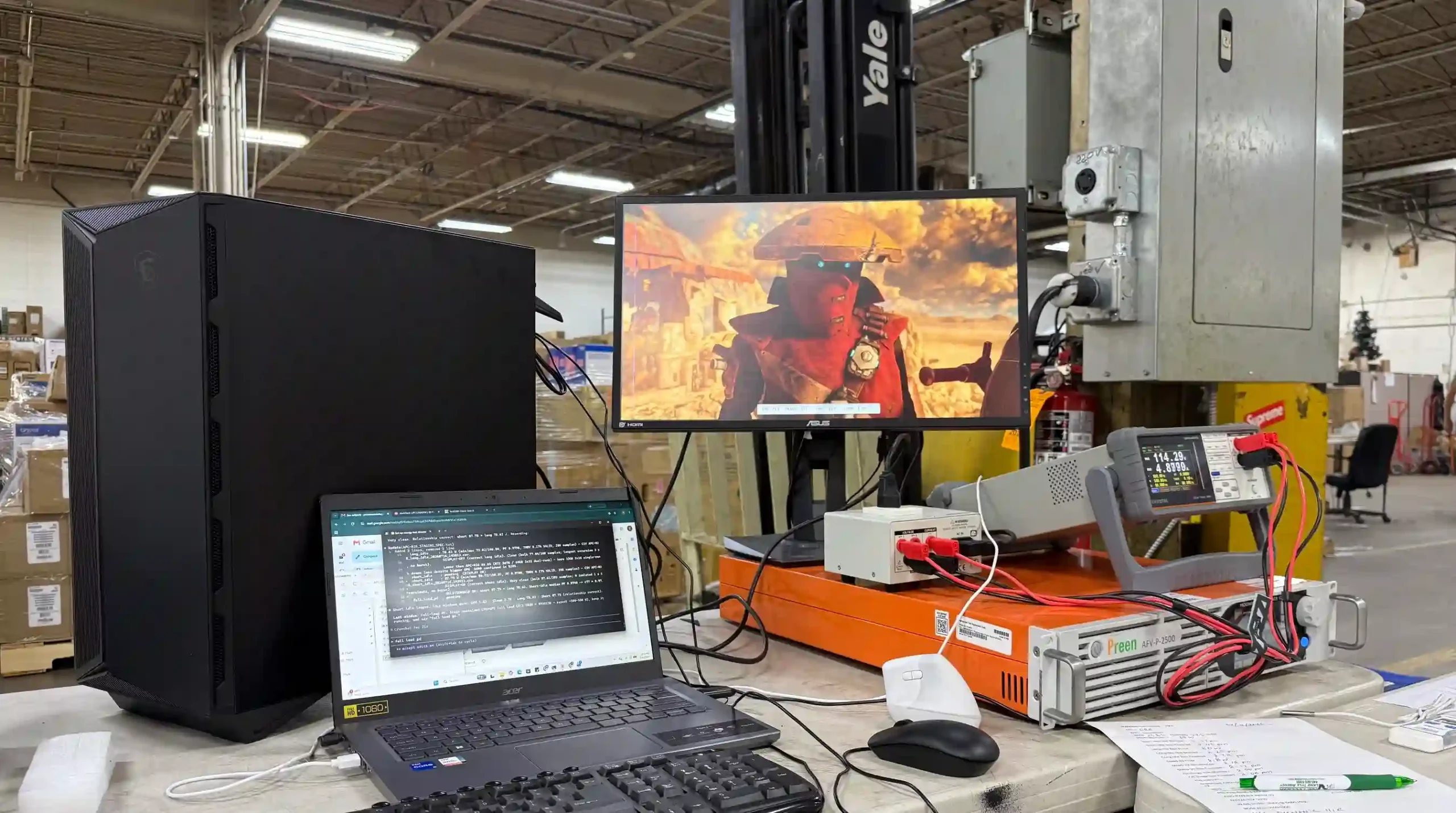
At ArsenalPC, “tested” means something specific. Every configuration goes through a full validation pipeline before it leaves the shop: stability under sustained load, thermal performance across the chassis, power draw at the wall, and acoustic behavior at both idle and full stress. That process surfaces dead-on-arrival parts and catches PSU faults before they reach your desk, which is exactly the point of a proper 24-hour burn-in run.
Why the Distinction Matters
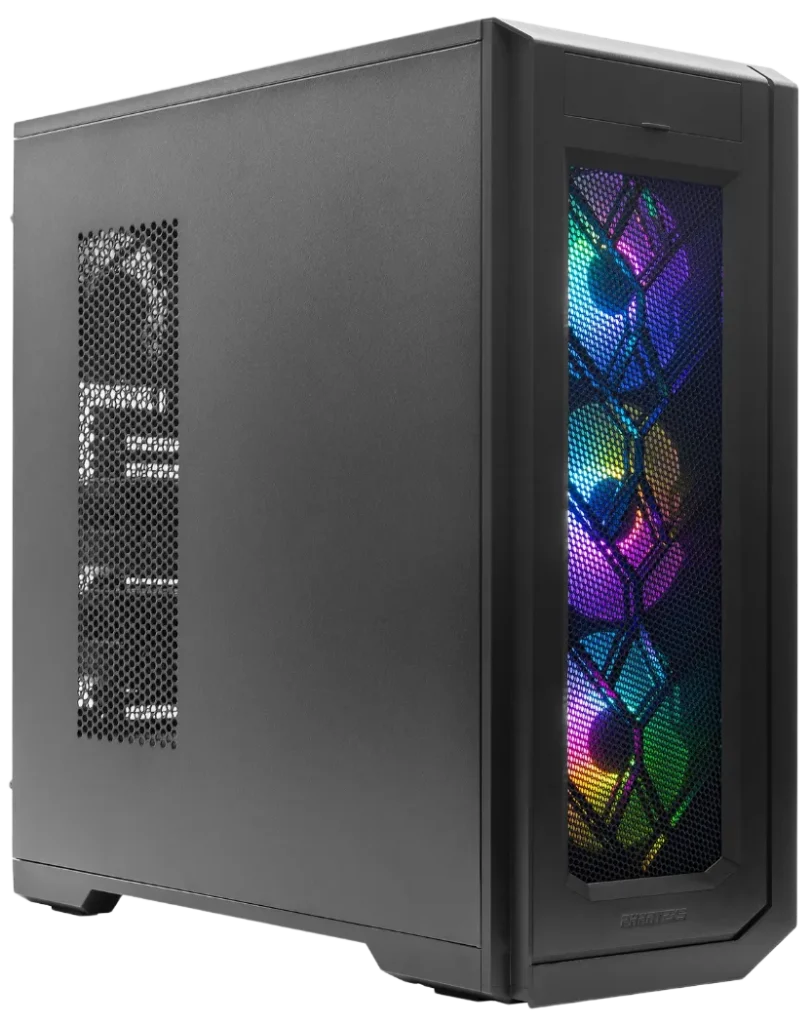
Mass-market assemblers building at volume routinely cut corners that buyers cannot see: inconsistent thermal paste application, cheap internal cabling, and cable routing that restricts airflow. Boutique builders hand-assemble from selected components and have the time to do the job correctly. The question of how to verify a prebuilt PC was properly tested before purchase is one buyers should ask directly, and the answer should be specific, not a general assurance.
ArsenalPC’s Lab Credentials: CEC MAEDbS Listed
The California Energy Commission’s Modernized Appliance Efficiency Database System (MAEDbS) is not a voluntary badge. Launched in August 2015, it is the CEC’s legal mechanism for tracking which regulated products are permitted to be sold in California. If a product is listed, it is compliant. If it is not listed, it cannot legally be sold or offered for sale in the state.
Manufacturers must test their products using CEC-required methods and certify the results directly to the MAEDbS. The CEC then uses that database to verify compliance and, when necessary, issue penalties. Those penalties are significant: California Code of Regulations, Title 20, Section 1609 sets the ceiling at $2,500 per unit per violation. That exposure gives the certification real teeth and separates builders who have done the work from those who have not.
Max Fine Per Unit
California Code of Regulations, Title 20, Section 1609 sets this ceiling per unit per violation, giving the CEC certification real enforcement teeth.
MAEDbS Launch Year
The CEC launched the Modernized Appliance Efficiency Database System in August 2015 as the legal mechanism for tracking compliant products sold in California.
Searchable Database
Any buyer can verify ArsenalPC’s listing independently at cacertappliances.energy.ca.gov, search by manufacturer name and confirm it yourself.
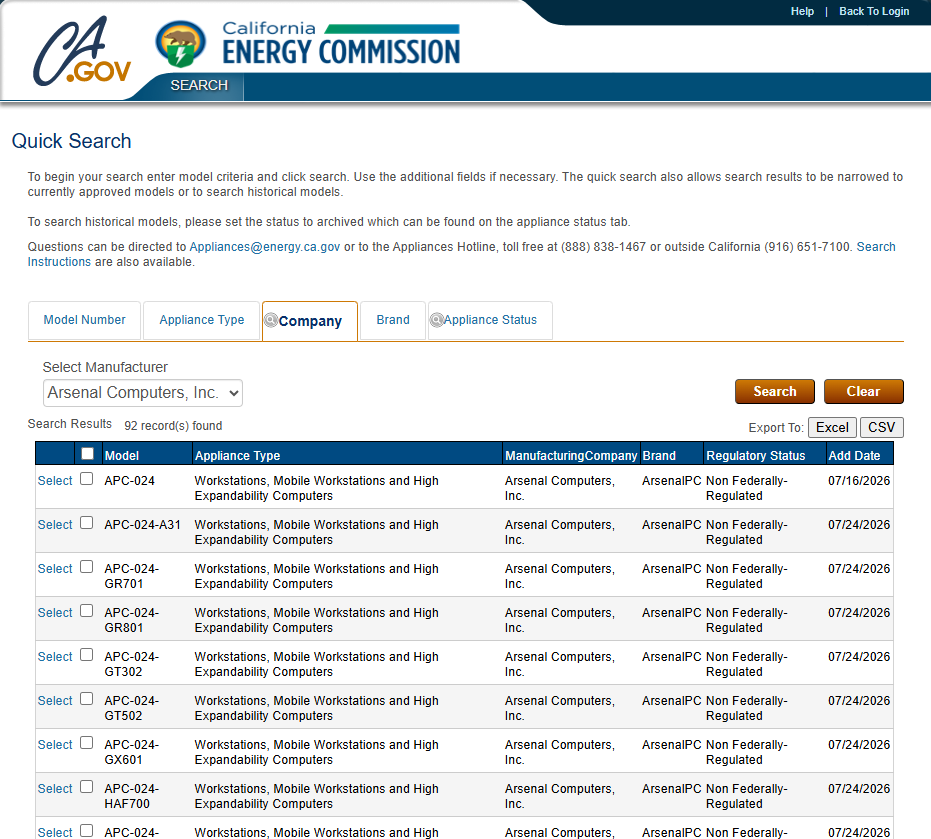
ArsenalPC is listed in the MAEDbS, which means our configurations have been tested against California’s Title 20 appliance efficiency standards and the results have been certified to the CEC. As a CEC MAEDbS certified gaming PC builder, we operate under the same compliance framework that governs major appliance manufacturers. You can verify our listing independently using the CEC’s public search tool at cacertappliances.energy.ca.gov. Search by manufacturer name and confirm it yourself.
What CEC Certification Covers
A common question we hear is what does CEC Title 20 cover for desktops and workstations specifically. The answer is broader than most buyers expect. The California Energy Commission’s appliance efficiency regulations cover desktops, thin clients, mobile gaming systems, small-scale servers, and rack-mounted workstations, among other product categories. That scope maps directly onto the systems we build and configure at ArsenalPC, from entry-level gaming desktops to the rack-mounted workstations we offer for AI and professional compute workloads.
Certification under Title 20 is not self-reported. The CEC requires manufacturers to submit verified energy consumption data before a product can be sold into California or listed in the MAEDbS database. That data includes power draw at various load states, size information, and brand details tied to specific model numbers.
Looking Up ArsenalPC in MAEDbS
The MAEDbS database is publicly searchable by model number, appliance type, or company name. Any reader can go to cacertappliances.energy.ca.gov and search for ArsenalPC directly. What comes back is not a marketing claim. It is a regulatory record showing the specific configurations we have submitted, the energy data attached to each, and the certification status. That level of transparency is something a mass-market assembler building to order without formal certification simply cannot offer.
FCC Authorization for AI Workstations
Every ArsenalPC AI workstation that ships with wireless connectivity, or that contains a processor, falls under FCC equipment authorization rules. The FCC’s framework exists to minimize harmful interference and ensure compliance with RF exposure limits. For buyers, FCC authorization is a concrete, verifiable trust signal, not a self-reported claim.
Certification vs. SDoC
The FCC uses two authorization procedures. Full Certification is issued by an FCC-recognized Telecommunication Certification Body and applies to higher-risk device categories, particularly those with active RF transmission. Supplier’s Declaration of Conformity (SDoC) applies to equipment containing only digital circuitry, such as computer peripherals and switching power supplies, though manufacturers may optionally pursue full Certification for those products as well.
AI workstations typically carry components that trigger both paths. A system with Wi-Fi, Bluetooth, or any other RF technology requires Certification for those radios. The digital subsystems, including the processor itself, fall under SDoC requirements. An FCC authorized AI workstation prebuilt has cleared both layers before it reaches a customer.
Verifying Authorization and Cross-Border Scope
FCC authorization for the US market frequently satisfies parallel requirements in Canada and many EU countries, though each regulator maintains its own labeling rules. Buyers operating in those jurisdictions should confirm specifics with their local regulator. To verify any device independently, the FCC Equipment Authorization database lets you search by manufacturer name or FCC ID number and review the full authorization record.
The ArsenalPC Configuration Testing Process
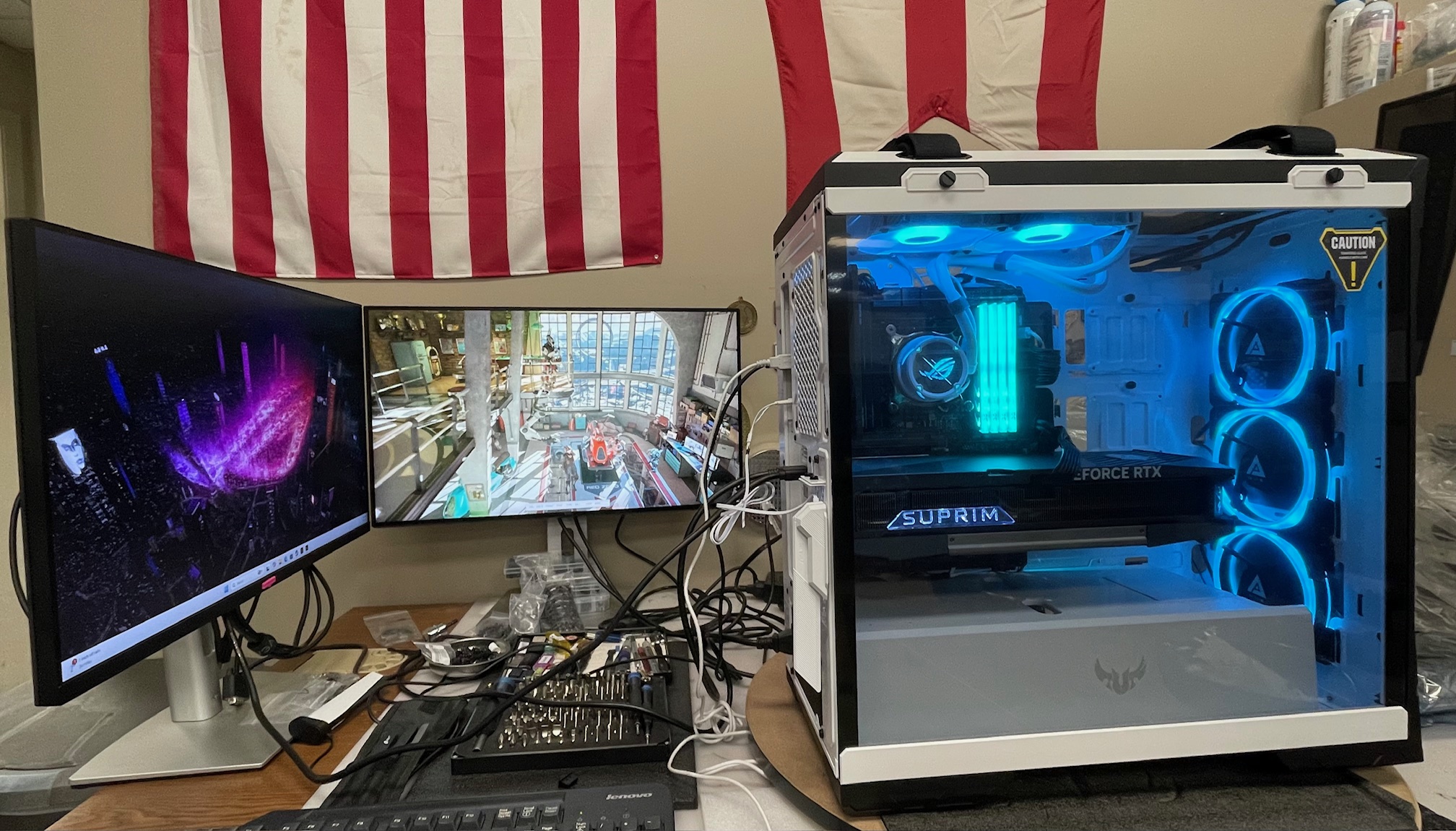
Every configuration listed on our site has already cleared a full pre-sale validation pipeline before a customer ever sees it. That is a deliberate policy. Buyers are not beta testers, and we do not treat a completed build as shippable simply because it powers on and boots into Windows.
The standard we hold ourselves to is consistent with what serious boutique builders practice across the industry. Ironside Computers, for example, has each build reviewed by a senior technician before testing even begins, then runs multiple benchmark programs to stress each individual component harder than a typical customer ever would, with the goal of catching and correcting any issues before shipment. VRLA Tech stress tests every build for 48 hours, verifying thermal stability rather than assuming it. These are the benchmarks we measure ourselves against.
What the Pipeline Covers
Stability Testing
Sustained load across all components to surface thermal throttling, PSU faults, and memory instability that a boot-only check will never catch.
Performance Validation
Benchmark targets matched to the build’s category, frame rate floors for gaming configs, inference throughput and VRAM utilization for AI workstations.
Power Draw Verification
Wall-level measurement under full load confirms CEC compliance thresholds are met before the system leaves the shop.
Thermal Profiling
Worst-case workload temperature logging across all major components, with fan curve tuning and airflow path verification before the side panel closes.
Each phase has a pass/fail threshold. A build that does not clear all four does not ship. The subsections below walk through each phase in detail, including the specific tools, durations, and criteria we apply to gaming PCs and AI workstations respectively.
Stability Testing
Runs well beyond a quick power-on check. A 48-hour burn-in at full load surfaces PSU faults, thermal throttling, and RAM instability before the system ever reaches your desk.
Performance Validation
Every config is benchmarked against its category targets: stable 144 fps floors for gaming builds, inference throughput and VRAM utilization for AI workstations, before the listing goes live.
Power Consumption Testing
Measured at the wall under full load, the only reading that captures total system draw including PSU efficiency losses, and logged against CEC compliance thresholds.
Stability Testing, In Detail
Boot-only testing catches assembly errors. It does not catch a PSU with a marginal capacitor, a CPU cooler that throttles under sustained load, or RAM that passes POST but fails under extended memory pressure. Those faults surface only under prolonged stress, which is why our stability testing runs well beyond a quick power-on check.
Industry practice sets a floor of 24 hours of continuous burn-in, running all components at maximum load to confirm cooling headroom and rule out dead-on-arrival parts. We treat that as a minimum, not a target. A boutique PC builder stress test that runs 48 hours before shipping, with thermal stability verified at intervals rather than assumed at the end, gives a much clearer picture of real-world behavior. That 48-hour standard is consistent with what other serious builders publish: VRLA Tech, for example, holds every build to that threshold before it leaves the shop.
- CPU and memory: sustained prime-load workloads to surface thermal throttling and instability under full core utilization
- GPU: looped synthetic and real-game workloads to confirm VRAM stability and cooling performance under continuous draw
- PSU: full-system load sustained long enough that a marginal unit will fail in the shop, not at the customer’s desk
Ironside Computers uses a similar philosophy: a senior technician reviews each build before it enters testing, then multiple benchmark programs stress each component individually, with the explicit goal of pushing the system harder than the customer ever will. The specific hour counts vary by builder, but the underlying logic is the same. Faults caught before shipment cost a technician’s time. Faults caught after shipment cost the customer’s trust.
Performance Validation, In Detail
Stability testing confirms a system won’t crash. Performance validation confirms it will actually do the job it was sold to do. Before any configuration goes live on our site, we benchmark it against the workload targets that define its category.
For gaming configurations, those targets are frame rate floors and frame time consistency at the resolution and quality settings the build is positioned for. A mid-range 1080p gaming system needs to hold a stable 144 fps in the titles our customers actually run, not just in synthetic benchmarks. A high-end 4K configuration gets evaluated against GPU-limited workloads where VRAM capacity and memory bandwidth matter as much as raw shader throughput.
AI workstation configurations carry a different set of targets. We look at inference throughput, VRAM utilization under sustained load, and whether the CPU-to-GPU data pipeline creates any bottlenecks during batch processing. A configuration that passes stability testing but throttles during a 30-minute inference run does not ship as an AI workstation.
The component-level approach is consistent with how other serious builders operate. Ironside, for example, runs multiple benchmark programs specifically to stress each individual component harder than a typical customer ever would, so any latent issues surface before shipment rather than after. We apply the same logic: the goal is to find the failure mode in our shop, not in yours.
Power Consumption Testing, In Detail
Every system we ship gets measured at the wall under full load, not at the component level. Power consumption testing on a prebuilt PC at the wall is the only measurement that captures the full picture: CPU draw, GPU draw, storage, fans, and the efficiency losses inside the PSU itself. A component’s rated TDP tells you nothing about what the system actually pulls from the outlet once everything is running together.
This matters directly for CEC energy efficiency compliance. California’s appliance regulations are based on real-world power draw, not manufacturer TDP figures. Our wall-level measurements confirm that each configuration meets the efficiency thresholds required for our CEC MAEDbS listing before the system leaves the shop.
Our methodology covers two states:
- Idle: system at desktop, no active workload, fans at baseline speed
- Full load: CPU and GPU stressed simultaneously, sustained for a minimum run period
Both readings get logged against the build record. If a system draws more than expected at idle, that often points to a power plan misconfiguration or a component not entering its low-power state correctly. Catching that before delivery is straightforward. Catching it after the fact, once the system is in a customer’s home, is not.
Thermal and Airflow Verification
After power consumption is logged, every build moves into sustained thermal testing. We run the system under full CPU and GPU load for an extended period while logging temperatures across all major components. The goal is to confirm that nothing throttles, no junction temperature climbs toward its limit, and the cooling solution performs as specified under real workload conditions.
Fan curves get explicit attention. We verify that each fan ramps correctly at defined temperature thresholds and that the curve produces acceptable acoustics at both idle and load. A fan curve that is too aggressive creates unnecessary noise. One that is too conservative allows temperatures to creep. We tune and confirm both ends of that range before a system ships.
Thermal paste application is part of this check. Mass-market assemblers frequently apply paste incorrectly, whether too little, too much, or unevenly spread, and the resulting contact between the heat spreader and cooler base is poor. We apply paste by hand on every build and verify the outcome through temperature data, not assumption.
Cable management feeds directly into airflow. Bundled or poorly routed cables can block intake fans or disrupt airflow across the GPU. We route cables behind the motherboard tray where possible and confirm that the interior airflow path is clear before the side panel goes on.
Why This Matters for AI Workstation Buyers Specifically
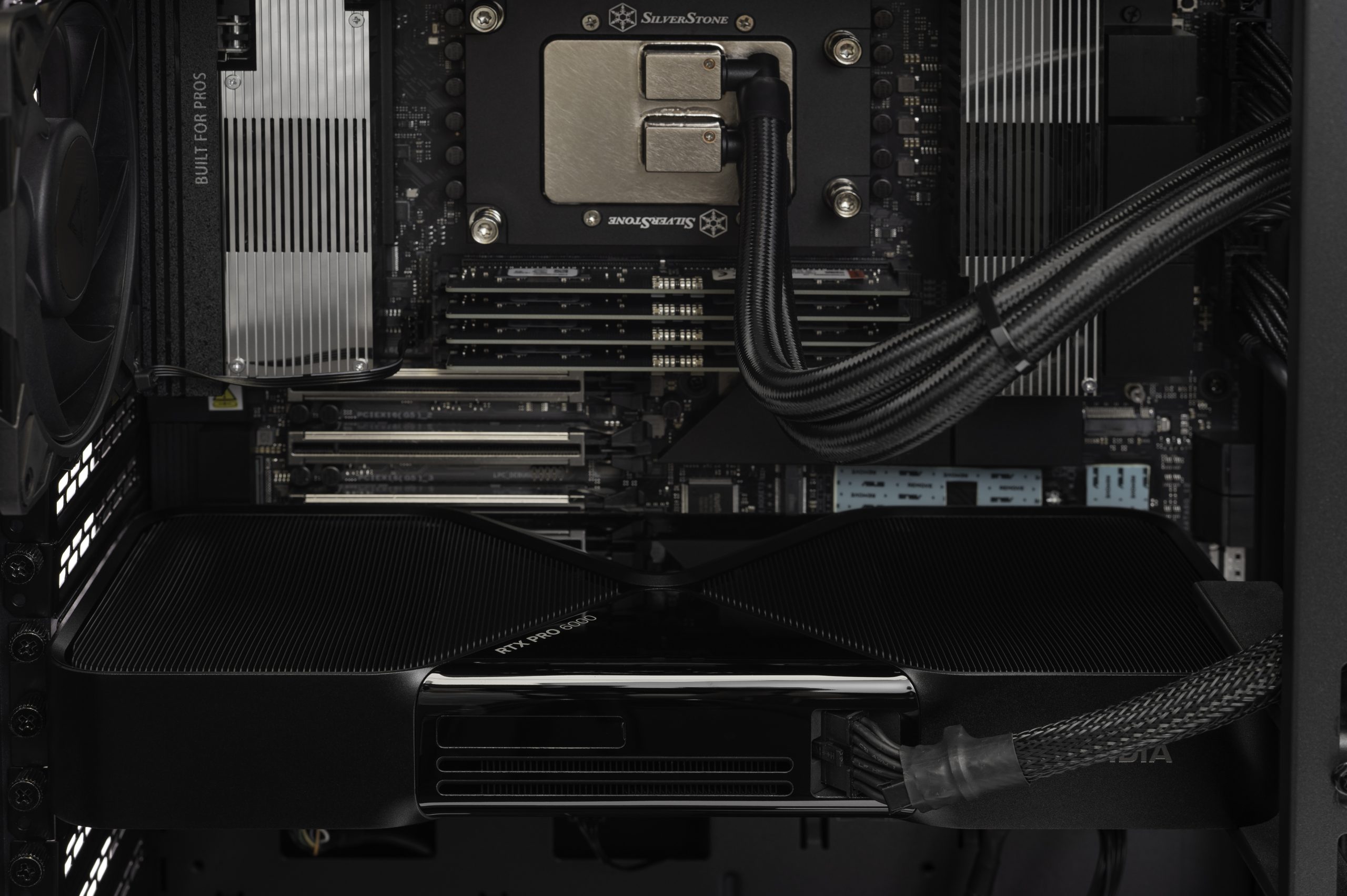
AI training workloads are among the most demanding conditions any PC hardware will ever face. Unlike gaming, which produces load spikes separated by lighter frames, a training run holds the GPU and CPU at near-maximum utilization for hours or days at a time. A configuration that has not been validated under those sustained conditions is a liability, not an asset.
The hardware in a current AI workstation reflects that reality. We build configurations around components like the NVIDIA GeForce RTX 5090, which carries 32 GB of GDDR7 memory, paired with processors such as the AMD Ryzen 9 9950X or Threadripper, and 64 to 128 GB of DDR5 system memory. Total system draw under a real training workload can be substantial, and that sustained draw stresses the power delivery, cooling, and memory subsystems simultaneously.
A prebuilt AI workstation validated for training workloads has to be tested under exactly those conditions before it ships. Our FCC-authorized systems go through the same stability, power, and thermal pipeline described throughout this article, with test durations and load profiles matched to real inference and training scenarios. That is what separates a validated configuration from a parts list assembled and boxed without verification.
Every Configuration on the Site Has Already Passed
When you see a configuration listed on ArsenalPC, it has already cleared the full pipeline: stability, performance, power, thermals, and regulatory compliance. You are not a beta tester. You are not the first person to run that system hard. We have already done that work before the listing goes live.
That commitment is verifiable, not just stated. Our CEC listing is publicly searchable in the MAEDbS database by company name, model number, or appliance type. The MAEDbS system exists specifically so buyers and regulators can confirm which products are legally compliant for sale in California. Look us up. Our FCC authorization is equally public: the FCC Equipment Authorization database lets anyone verify our FCC ID and authorization status directly from the agency’s own records.
These are not self-reported claims. They are third-party database entries that carry real consequences. Non-compliant sellers face CEC fines of up to $2,500 per unit sold under California Code of Regulations, Title 20, Section 1609. We cleared that bar because every system we ship is built to clear it.
Decision
Start with a configuration that has already proven itself.
If you are configuring a gaming PC or an AI workstation, build on a foundation that has been tested, logged, and verified before it ever reached you. Our CEC MAEDbS listing and FCC authorization are publicly searchable, the credentials are real, and so is the pipeline behind them.
Browse the ArsenalPC Configurator →
Frequently Asked Questions
Yes. The MAEDbS database is publicly searchable at cacertappliances.energy.ca.gov. You can search by company name, model number, or appliance type and pull up the actual regulatory record, including the energy consumption data and certification status tied to specific model numbers. No account or login is required. What you see is a live CEC database entry, not a manufacturer-supplied document, so the information reflects what was formally submitted and verified by the agency.
California’s Title 20 appliance efficiency regulations cover a broader range of product categories than most buyers expect. Desktops, thin clients, mobile gaming systems, small-scale servers, and rack-mounted workstations all fall within scope. That means a high-end gaming desktop or an AI training workstation built around a flagship GPU is subject to the same certification requirements as an entry-level office machine. Builders who skip certification are not exempt because their products are powerful; they are simply non-compliant.
A regulated appliance that has not been certified to the CEC cannot legally be sold or offered for sale in California. Sellers found in violation face administrative civil penalties of up to $2,500 per unit per violation under California Code of Regulations, Title 20, Section 1609. Because the penalty applies per unit, a seller moving even a modest volume of non-compliant systems faces substantial cumulative exposure. The CEC uses the MAEDbS database to actively verify compliance and issue those penalties, so the risk is not theoretical.
FCC Certification is issued by an FCC-recognized Telecommunication Certification Body and is required for higher-risk device categories, particularly those with active RF transmission such as Wi-Fi or Bluetooth radios. Supplier’s Declaration of Conformity applies to equipment containing only digital circuitry, like switching power supplies and computer peripherals, though manufacturers may optionally pursue full Certification for those components as well. A complete AI workstation with wireless connectivity typically requires both paths: Certification for the RF radios and SDoC for the digital subsystems.
FCC testing for US market authorization often satisfies the technical requirements of other countries, particularly Canada and many EU member states, because the underlying test methods overlap significantly. However, each regulator maintains its own labeling requirements and may require a separate declaration or registration. Buyers operating outside the United States should confirm jurisdiction-specific requirements with their local regulatory authority before assuming US FCC authorization is sufficient for commercial or enterprise deployment in another country.
CEC MAEDbS certification and FCC equipment authorization are tied to specific assembled configurations submitted and tested by the manufacturer, not to individual components. When ArsenalPC certifies a configuration, the submission covers that system as a complete unit, including its measured power draw at defined load states and its RF behavior as assembled. A self-built system using similar parts has never been submitted to either agency as a complete product, so no regulatory record exists for it regardless of which individual components were used.
A component’s rated Thermal Design Power reflects the heat that component is designed to dissipate under load, not the total electricity drawn from the outlet. Wall-level measurement captures the combined draw of every component in the system, including CPU, GPU, storage, fans, and the efficiency losses inside the power supply unit itself. California’s Title 20 efficiency thresholds are based on real-world system power draw, not manufacturer TDP figures, so only a wall-level reading can confirm that a configuration actually meets the CEC compliance threshold required for a valid MAEDbS listing.
The CEC’s appliance efficiency standards were first developed in 1977, making them one of the longest-standing product efficiency frameworks in the United States. The MAEDbS database that tracks compliance for modern regulated products, including desktops and workstations, launched in August 2015 as the CEC’s digital mechanism for verifying which specific models are legally permitted for sale in California. The requirement is not new, but many buyers are unaware that the PC they are considering may not be listed, which is precisely why the public search tool exists.
Need Help Choosing the Right PC?
ArsenalPC is based in Willoughby, Ohio, with 27+ years of custom PC building experience. Every configuration we sell has been hand-assembled, stress-tested, and verified against CEC and FCC standards before it ships. Whether you need a validated gaming rig or a fully tested AI workstation, our team is here to help you build with confidence.
- Phone: 866-277-3627 (Toll-Free) | 440-602-7090 (Local)
- Email: Contact Form
- Visit: 4711 E355 St, Willoughby, OH 44094
- Hours: Mon, Fri 10AM to 6PM | Sat 11AM to 3PM