
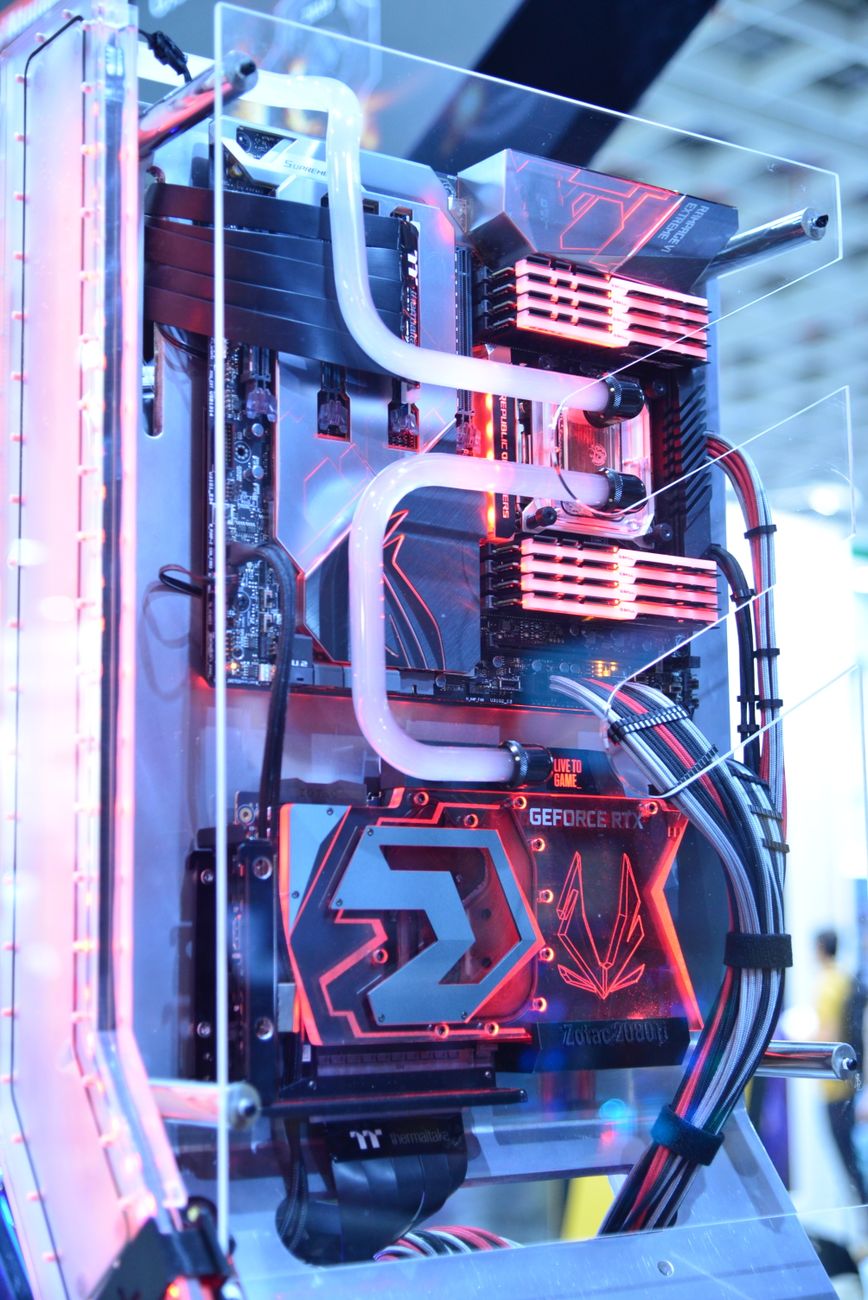

A custom liquid cooling loop costs roughly $600 to $1,000 in parts in 2026. That’s 3 to 5 times the price of a 360mm AIO. You’ll also change the coolant every 6 to 12 months, depending on the fluid, and strip the loop down for a full clean about every 24 months.
We think most buyers should start with an AIO. A custom loop mostly gets you quieter fans and a cooler GPU, so it only makes sense when you’ll notice those two things.
AIO or custom loop: what you are actually buying
An AIO is a sealed CPU cooler, while a custom loop is a set of separate parts that can cool the GPU too. The AIO arrives filled and closed, with the pump, block, tubing and radiator already joined. For a custom loop, you choose the CPU and GPU blocks, the pump and reservoir, the radiators, and the fittings and tubing. Then you cut, fit and fill them yourself.
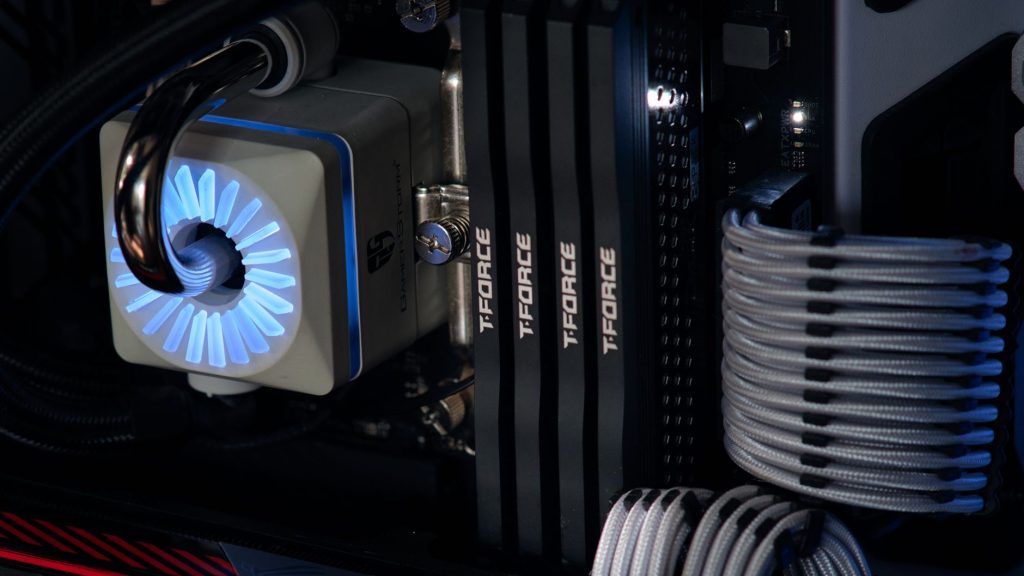
Labor is the other big difference. ThermalStats estimates the install times below.
| Build | Time to install |
|---|---|
| AIO | About 20 min |
| Custom loop, experienced builder | 2 to 3 hours |
| Custom loop, first build | 4 to 8 hours |
If it’s your first loop, save it for a free day so you don’t have to rush the fitting or filling.
Where a custom loop beats a 360mm AIO
A custom loop wins on noise and GPU temperatures. It won’t make your CPU much cooler than a good AIO, but it can run its fans slower and still keep up. A HardForum user compared a custom loop with a 280mm AIO, one size smaller than a 360mm AIO. The loop’s fans ran 400 RPM slower than the AIO’s, and CPU temperatures rose only 1.5°C. The loop still beat the AIO.
That’s a single community test, so don’t treat it as a rule. On the CPU side, noise is what you’re paying for.
The bigger gain is the GPU. An AIO only cools the CPU, so the graphics card still dumps its heat through its own fans. A full cover block sends that heat to the radiators instead, which makes a high-power card run cooler and quieter. If the CPU is the only part you want cooler, a 360mm AIO gets you almost all of the benefit for much less money.
What a custom loop costs to buy
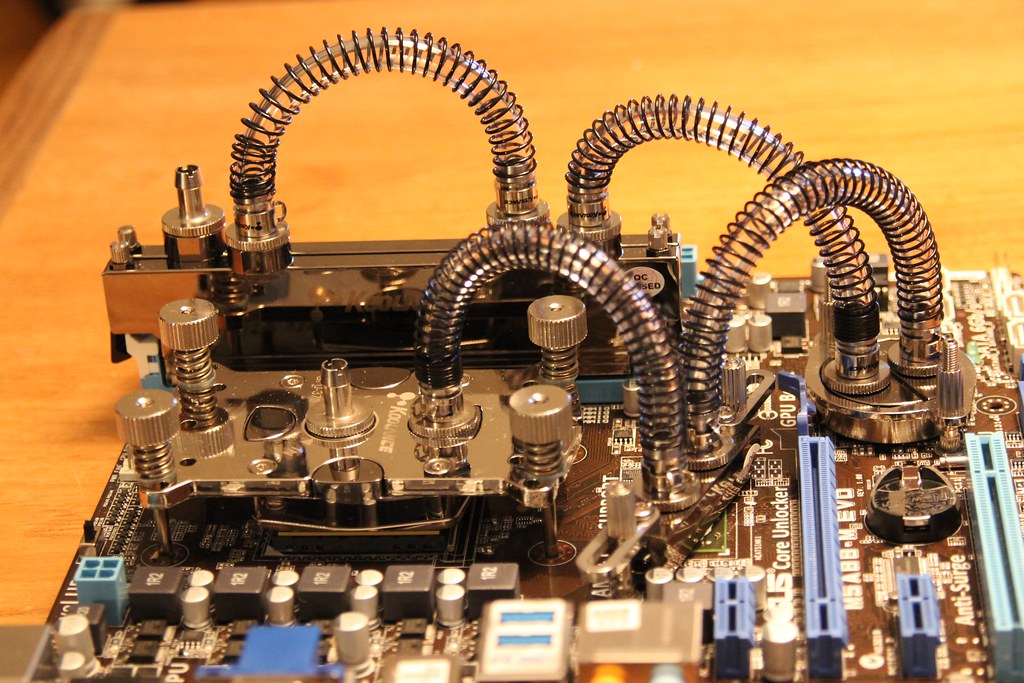
Most of that $600 to $1,000 goes to two parts: the pump/reservoir and the GPU block. A D5 pump/reservoir combo costs $170 to $300 at Corsair’s list prices. A May 2026 buyer’s guide prices an RTX 5090 full cover block at $275 to $425. For comparison, Tech Insider prices a complete 360mm AIO at $130 to $220.
Extras set most of the pump price. Above the base combo, the extra money pays for iCUE LINK control and, on the $299.99 model, an LCD screen. Custom PC called the $299 price “very expensive for a reservoir/pump combo unit.” TechPowerUp reviewed the original XD5 in 2019 at $154.99, so the basic pump has risen only $15 in seven years. We’d buy the plain combo and spend the savings on radiator area.
Some estimates come in lower. FormulaMod, a parts retailer, quotes $150 to $250 for a CPU-only loop and $400 to $700 for a full loop with premium parts. We’d still budget the higher range if your loop includes a GPU block. Parts lists also often leave out a few small costs:
- Drain valve: FormulaMod says a ball valve costs under $10. Without one, you have to undo fittings inside the case to drain the loop, and coolant can spill onto your hardware.
- Hub or controller: the $299.99 LCD combo needs an iCUE LINK System Hub, which Corsair sells separately.
- Spare coolant: you’ll need it for the first top-up after air bleeds out, and again at every refill.
How often a custom loop needs maintenance
Plan on a coolant change about every 12 months and a full teardown every 24 months. Corsair and FormulaMod both give the 12 month figure. EKWB says the pump itself needs no regular maintenance, but it still recommends a distilled water flush every year or so.
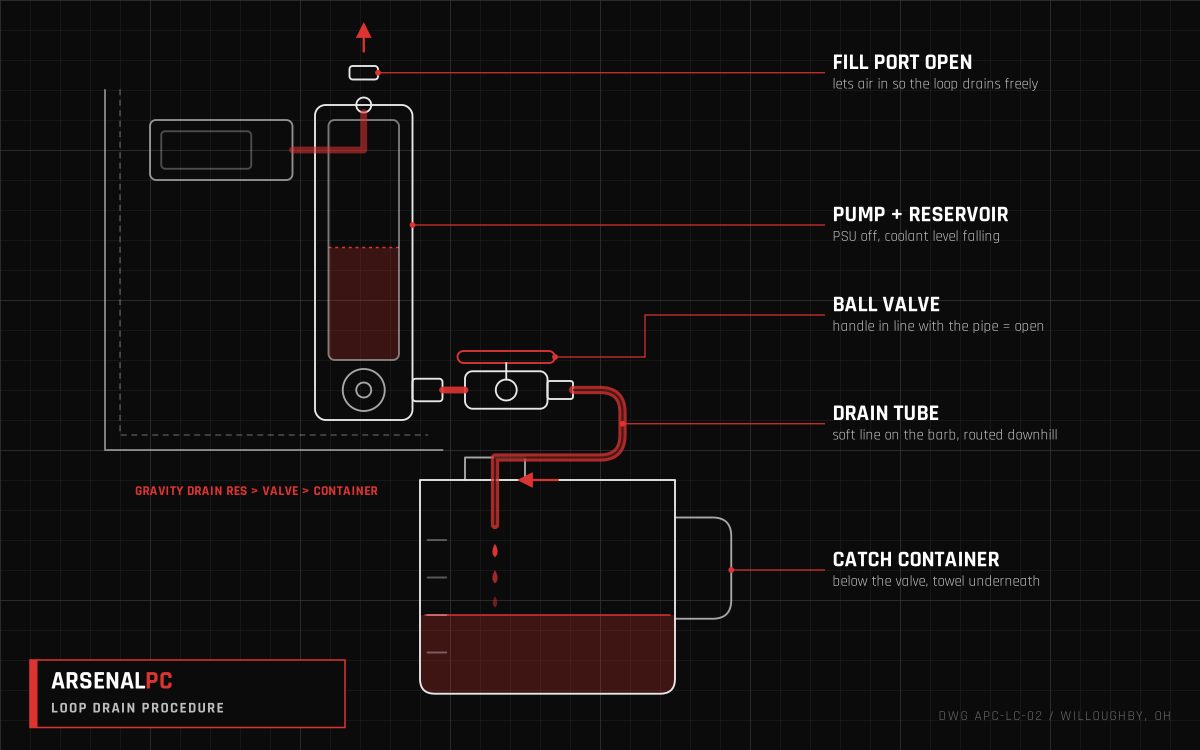
The refill is cheap. FormulaMod recommends distilled water below 5 µS/cm with an inhibitor or biocide such as Mayhems X1 or Feser One. It puts the cost at under $20 for a typical 1 to 2 liter loop. Your time costs more than the fluid. A ball valve drain keeps the job short.
The teardown takes much longer. FormulaMod says to inspect the microfin channels in the blocks, replace any discolored tubing and flush the radiators. Corsair notes that some loops run for years without trouble while others show problems within months. So change the coolant early if clear fluid turns cloudy or colored fluid fades.
Clear coolant means less work than pastel
Pastel and opaque coolants need changing every 6 months, twice as often as clear fluid. Particles suspended in the fluid give pastel its color. Over time they settle and clog the microfin channels in the blocks, so the 24 month teardown has more buildup to clean out.
Clear premixes and concentrates last the full 12 months. FormulaMod estimates they run 1 to 2°C warmer than distilled water, against 3 to 5°C for pastel. Those temperature figures are a retailer’s estimates, but the maintenance gap is clear. We’d fill with clear coolant and get the color from tinted tubing or lighting.
Keep aluminum out of a copper loop
Build the loop from copper and brass parts only. Mixing aluminum and copper causes galvanic corrosion, which eats away the aluminum and leaves deposits in the blocks. Corsair rates the XD5 combo for copper and brass only, so one aluminum radiator puts your loop outside the pump’s rating.
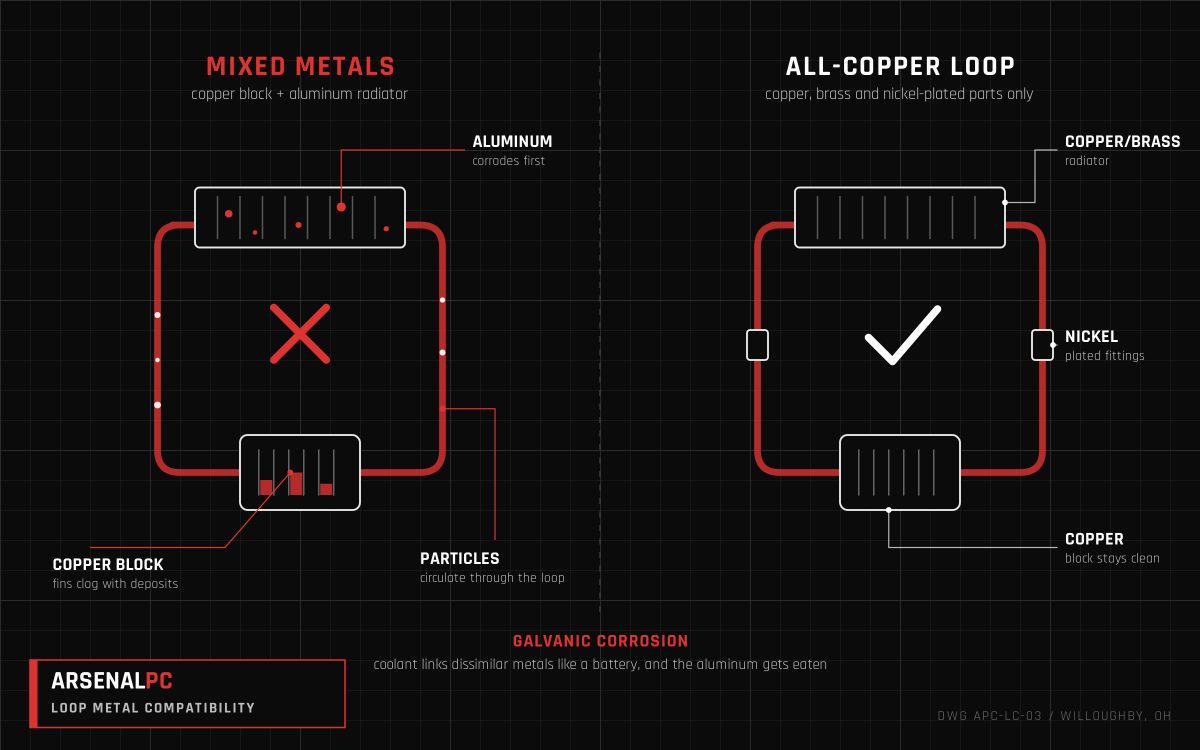
Coolant makers warn against aluminum too. PrimoChill’s ICE coolant text calls aluminum “strongly discouraged” and says using it voids the fluid warranty.
A single-brand loop carries the least risk. Corsair says a loop built only from Hydro X parts and its XL coolant, which is 89% pure water, generally has no compatibility issues because Corsair tests those parts together. If you mix brands, check the metal listing on every radiator and fitting before you buy.
What happens when a cooling vendor stumbles
Spare parts can stop arriving. EKWB’s 2024 to 2025 crisis left about €300,000 in prepaid orders unfulfilled, according to EK’s own transparency site. That total peaked on 26 June 2025 and covered about 1,100 customer records.

The trouble became public in early 2024, when Igor’s Lab reported unpaid EKWB invoices. GamersNexus, Tom’s Hardware, KitGuru and PC Gamer published investigations between April 2024 and February 2025. The Slovenian Labour Inspectorate then opened its own probe. EK sent orders placed after 10 April 2025 through LM TEK’s shop.
The older orders are clearing slowly. EK’s dashboard showed 31 of 543 legacy orders resolved, which is 6%. If you own an EK loop, a replacement block or pump top may not arrive when you need it.
A loop can outlast its vendor, so we’d build around standard parts. D5 pumps, G1/4 fittings and copper radiators come from several makers, so another brand’s part can replace a failed one. The GPU block fits only one card model. Buy that block from a vendor with stable support and spares in stock.
Is a custom loop worth it for your build?
Prebuilt AI Workstations
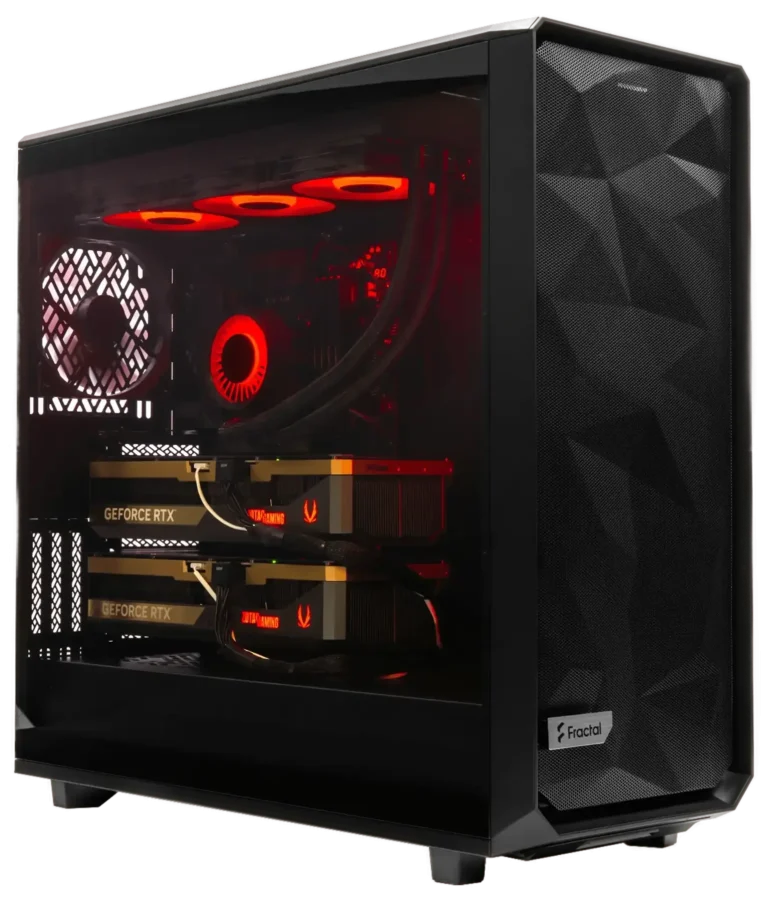
Meshify 2XL Liquid Cooled Custom AI Workstation: RTX 5090 GPU, DDR5 128GB, Ryzen 9 9950X3D 16C 4.3GHz, 4TB NVMe SSD
$12,260.99
Prebuilt AI Workstations
Meshify 2XL Liquid Cooled Custom AI Workstation: Radeon AI Pro R9700 32GB, DDR5 128GB, Ryzen 9 9900X 12C 4.4GHz, 2TB NVMe SSD
$7,171.00
Prebuilt AI Workstations
Meshify 2XL Liquid Cooled Custom AI Workstation: Arc Pro B70 32GB, DDR5 32GB, Ryzen 9 9900X 12C 4.4GHz, 1TB NVMe SSD
$4,901.00
A custom loop is worth it for a high-wattage GPU build where you want quiet operation and you’ll do the yearly coolant service. If you only need to cool the CPU, a 360mm AIO is the better value. We’d point most first-time buyers to one. Four things decide it:
- GPU wattage: a 5090-class card is where a full cover block makes the clearest difference.
- Noise tolerance: the loop’s CPU-side gain is slower fans, so pay for it only if fan noise bothers you.
- Yearly service: if you won’t drain and refill every 12 months, buy the AIO.
- Looks: hardline tubing and a visible reservoir are reasons in their own right.
If all four point to a loop and you’d rather skip the build, ArsenalPC builds custom loops in Willoughby, Ohio.
Frequently Asked Questions
No. Tap water carries minerals that can leave deposits in the blocks. Use distilled water with an inhibitor or biocide added, which costs very little more.
Usually not by much. A loop adds little CPU cooling over a good 360mm AIO, so CPU clocks barely change. You’ll mostly notice quieter fans and a cooler GPU. A cooler GPU may hold its boost clock a little longer.
Corsair rates its iCUE LINK XD5 combo for a maximum coolant temperature of 60°C. If your loop gets close to that under load, add radiator area or raise your fan speeds. Other pumps have their own limits, so check yours before you push it.
Corsair gives the iCUE LINK XD5 RGB ELITE combo a 3 year warranty. The combo lists at $219.99 as of October 2026.
Need Help Choosing the Right PC?
ArsenalPC is based in Willoughby, Ohio with 27+ years of custom-build experience. Every system we ship is hand-assembled and stress-tested for a minimum of three hours before it leaves the shop, and our team is available to help you match the right configuration to your workload, display, and budget.
- Phone: 866-277-3627 (Toll-Free) | 440-602-7090 (Local)
- Email: Contact Form
- Visit: 4711 E355 St, Willoughby, OH 44094
- Hours: Mon-Fri 10AM-6PM, Sat 11AM-3PM